
MULTISPECIES ETHNOGRAPHY
AND ARTFUL METHODS

7. FARMING COWS AND WORMS


Montage companion
Farming Cows and Worms brings together some of the collective ponderings inspired by our individual Ph.D. research on farming. Hanna studies human-animal relationships in regenerative cattle farming in Sweden, trying to understand the agricultural shapeshifting that is suggested by this alternative model of farming. Specifically, she focuses on what environmental knowledges and ethical relations are produced, and how. Simone studies the development and meaning of smallholder organic farming and permaculture in Kyrgyzstan, focusing on the creation of ‘good farmer’ identities in relation to changing perspectives and practices of more-than-human engagement.
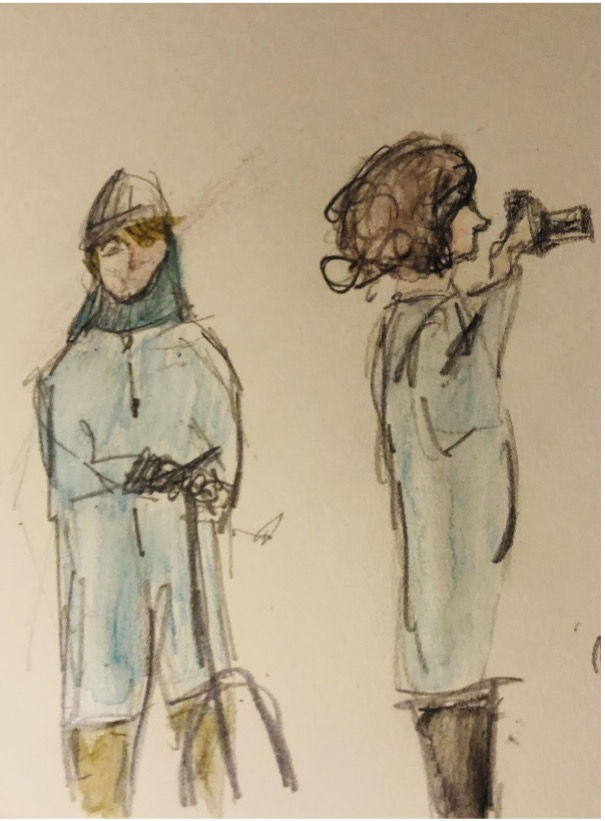
In 2022, we attended a winter school on ‘Digital Visual Engagements in Anthropological Research’ at Leiden University, the Netherlands. This became the starting point for our artful research collaboration. We think of our joint research process as ‘cross ethnography’: we share our more or less raw research materials – consisting of different media – with each other and interpret and respond to them in both written and (audio)visual formats. It is an iterative mode of working where we create cross interpretations of materials from our individual fieldwork. Through these ‘creative respondings’ (Thorpe et al., 2023), the research process is emphasised (see also Matsutake Worlds Research Group, 2009).
This montage is the product of the creative forces of cross ethnography: it is a multimedia exploration of how we can make sense of the more-than-human relationships we encountered on Swedish farmyards and around Kyrgyz compost heaps. Being spaces of agricultural production, these sites host multispecies relationships that are characterised by human use and, oftentimes, killing. However, as Donna Haraway points out, ‘[t]o be in a relation of use to each other is not the definition of unfreedom and violation’ (2008:74). We should allow for relationships of use to, potentially, be good ones. So, we wonder: how can we make sense of ‘good’ relationships of use? What do they look, feel, sound, taste, smell like? In this work, we are guided by the notion that both the ‘good’ and the ‘bad’ make more-than-human entanglements (Govindrajan, 2018; Bear and Holloway, 2019), and that ‘good’ and ‘bad’ are not always distinguishable. In ‘agrarian worlds’ (Galvin, 2018), love and mutuality are not opposite to violence and hierarchy. As we show in this montage, they can even go together in one act. This is emphasised by the chapter titles in which terms that are often thought of as juxtapositions are joined by ‘and’ or a comma, instead of ‘or’: Producing and Nurturing; Controlling and Supporting; Caring Enough, Caring Too Much; Keeping Alive, Ending A Life.
Open-endedness and continuous curiosity
Our method of cross ethnography and, subsequently, this montage, fit our understanding of ethnography as an open-ended way of working where the goal is to introduce the audience to lifeworlds in a way that sparks curiosity and encourages explorations (Ingold, 2011; Laplante, et al. 2020; Pink, 2015). This means we do not aim to serve up definite conclusions of what ‘is’, but to take the audience along in the process of experiencing, reflecting, and asking the critical questions. It is a move from representing to presenting (Ingold, 2002; Pitt, 2015).
The goal of ethnographic research is not to capture ‘a’ reality, but to come to understand and share temporally and socially situated versions of reality (Pink 2011, 2015; Ingold 2011). Artful methodologies accentuate this understanding of research. For instance, the soundscapes of this montage are not ‘sonic realities’ but rather ‘partial truths’ that aim to create new experiences while being indexically connected to our experiences in the field (Littlejohn, 2021:43). In our work, we are guided by Favero’s (2017) notion of ‘thin description’: the process wherein we experience, sense and feel, and where observations and perceptions have not been finally subjugated to description, interpretation and explanation.
In our collaboration, sharing our multiple-media materials through cross ethnography nurtures an ongoing dialogue between us that helps keep our minds open. By enabling us to re-view, and therefore re-engage, with our fieldwork contexts, artful materials invite us to come to understand our field experiences anew and thus appreciate multiple perspectives (Pink and Morgan, 2013; Freidenberg, 1998).
Multispecies and multisensorial
Our work is part of a contemporary movement in ethnography that explores how ‘ways of knowing are shaped by the affective and sensorial’ (Culhane, 2017: 11). This mode of ethnography goes beyond that what is written or said and understands knowing as a multisensory phenomenon.
This is key when researching multispecies socialities, because while we do not share language with nonhuman animals, we do share ‘contact zones’ (Haraway, 2008). Using artful methods, we explore how to account for embodiment, feelings, and creativity in these zones of contact (Culhane, 2017). Our work is premised on the notion that farmyards are formative meeting spaces shaped by and shaping multispecies entanglements (Galvin, 2018). To make sense of the agrarian worlds of this montage, we have ventured ‘beyond the human’ (Kohn, 2013: 7) and explicitly broadened the study scope to include nonhuman farm dwellers as co-responding ethnographic subjects. We have been doing ‘ethnographic hang-around’ (Pink, 2015) with human farmers, compost worms and cattle. In this research process, creative methods allow us to ‘make sense’ (Howes, 2019) differently and more intently.
Throughout the piece, we intentionally work with combinations of media to engage multisensory experiences. We use silences and blank screens to ‘pace’ the piece, creating a narrational rhythm to accentuate affective sensations and offer micro pauses for reflection.
We also explicitly use artful methods to foreground the nonhumans of this montage. Through photography, film and soundscapes we offer them space to ‘speak for themselves’ (Bear et al., 2017). While we cannot take ourselves out completely, these methods leave the doings and dwellings of nonhumans open for further interpretation. Drawings, on the other hand, act as visual explorations of the human imagination and experience – both our interlocutors’ and our own.
Creative writing is an important tool for us to process the multisensorial experiences we have in the field and to constructively explore the limitations that apply to knowing nonhuman perspectives and experiences. It allows space for emotional, affective and sensorial dimensions of interactions and nurtures a capacity to empathically imagine what the perspective of the other might be (Ingridsdotter and Sillow Kallenberg, 2018; Elliott, 2017; Richardson, 2000). Put differently, creative writing helps us approach the nonhumans while staying, humbly, on the human side of things.
Some challenges, to close
As likely is becoming clear, we find artful and collaborative methods to be powerful companions in multispecies research fields. Through cross ethnography, they also immensely enrich our Ph.D. journeys – journeys that are often described as lonely and tough. We would, however, like to end by offering a number of challenges for consideration with this methodology.
Firstly, (black) magic can be done during post-production. There is a tendency for audio-visual works to gravitate towards the aesthetically pleasing (Grasseni, 2009; Wernersson and De Boer, 2022). This risks creating blind spots, if what is not easily/prettily captured on camera/recording is left out. This means that the critical questions may not be asked. We find collaboration to be an effective tool to uncover aesthetic preferences that may push the material in a potentially less truthful direction. Yet, limitations apply. As a collaborative pair we too develop shared aesthetic and ethical standards, and our joint objectives may cloud our judgements. And while we use ‘we’ throughout this work, we are two different individuals holding different opinions and viewpoints (see also Gordon et al., 2006; Matsutake Worlds Research Group, 2009). The ethical question at play here evolves around how to create awareness and raise reflection around the mediation itself (De Musso, 2021).



Montage Guide
Part I: Producing and nurturing
Bull Life, Industrial Bull Farm, Sweden
Worm Life, Organic Farming Site, Kyrgyzstan
Ultimately, farming is humans doing things to nonhumans for productive purposes, deciding on the frames of nonhuman lives. What kind of lives do farming humans create, protect and grant in these processes of productive care (Harbers, 2010)? And how much space is there for co-creation?
In Bull Life, video gives us a feeling of ‘meeting’ the bulls. We are in the barn together with the bulls, yet not with them on their side of the fence. We are looking at them, not with them. Video and poem invite us to reflect on the multispecies relationship of this space: a living environment given and guaranteed by human hands. Yet, while space is human built, what the bulls do in and with that space is of their own making. The bulls are standing, walking, stopping, laying down, standing again; using all space that is given on their side of the fence.
Worm Life is a reaction to Bull Life in both style and content. When put into dialogue with one another, these poems enable a comparative pondering of different species lives.
While initially built by human hands, most of what goes on inside compost heaps is invisible to human eyes. It is a living environment that allows freedom of movement and agency to compost worms to rework it (Bennett 2010: 97). While the food is provided by humans, there is a logic of choice. The visuals in Worm Life represent the worms’ environment as experienced and understood by humans. The black screen invites us to imagine what happens beyond our sensory reach.
Part II: Controlling and supporting
Sweeping Care, Industrial Bull Farm, Sweden
Layering Labour, Organic Farming Site, Kyrgyzstan
Living spaces both shape and are shaped by multispecies care. In the high-tech industrial bull stable, caring is monitoring growth and keeping a safe distance. In low-tech Kyrgyz worm farming, caring is feeding, building and maintaining a safe environment.
As is evident in Sweeping Care, technology and built environments may tear species apart, but farm dwellers are not without a say and can resist these forces. In this piece, text and sound complement and contrast one another to get at a sensorial experience of the ambiguities that make farming (Wernersson and Boonstra, 2024; Wilkie, 2017). The written story introduces us to human emotions and feelings of attachment to animals, while the audible story introduces us to the nakedness and noisiness – or the rawness – of this human-built, industrialised, farm setting.
Layering Labour is an instructive compost building poem based on ethnographic material that draws attention to the materiality and sensorial dimensions of compost heaps and care practices with the aim to explore the connection and labour between worms and humans. By layering the compost heap, humans create an environment for worms in which the two species become simultaneously invisible and connected to each other. Worms and humans cannot see or (fully) comprehend the work the other does, but they can engage with the result of the other’s labour. Labour is the intersubjective connector across species lines (Porcher, 2017, 2020; Govindrajan, 2018; Jones, 2019).
Part III: Caring enough, caring too much
Exposing Care, Organic Farming Site, Kyrgyzstan
Mommy, Family Farm, Sweden
What is good for the nonhuman animal, what is good for the human, and is it possible to achieve what is good for both?
Exposing Care explores the way humans interact with worms, care for them and produce knowledge about them. Because worm lives are largely invisible, humans must draw on other senses and their imagination to come to know and manage worms. Sometimes, however, the boundary between visibility/light and invisibility/darkness must be transgressed. The process of becoming attuned to worms (Abrahamsson and Bertoni, 2014) thus involves possibly harming them.
Mommy tells us about a hierarchy of relationships at play. Farmer and cow are to have a good relationship to make business smooth running. Cows too, are to have good relationships and care for one another, but not to the extent that they threaten the human-cow relationship. It is humans that decide when there is enough, or too much, care (Emel et al., 2017).
Part IV: Keeping alive, ending a life
Warm Worms, Organic Farming Site, Kyrgyzstan
Rugged Friendships, Family Farm, Sweden
Having others care for your life can be both reassuring and perturbing (Govindrajan, 2018). Caring and nurturing do not preclude hurting and killing and, in farming, keeping alive and ending a life are not opposites. In Warm Worms and Rugged Friendships, drawings and narration address closeness and distance, love and death, and questions of power inherent to farming.
Warm Worms explores the dynamics between selfcare and human care. Worms can take their fate into their own hands when human care falls short but, in response, compost caretakers may change their practices and redirect the worms’ course. It is enacting both love and control (cf. Abrahamsson and Bertoni, 2014).
Rugged Friendships suggests that, rather than treating animals ‘as objects so that we can kill them’ (Bernadina, 1991:35 in Buller, 2013), to know the other well may be a prerequisite for eating, wearing or using the other as a rug. Through death, a closeness is created that is unattainable through life alone.

Artnographic statement
This multimedia montage explores multispecies relationships in three different farming contexts: human-worm relationships in Kyrgyz compost heaps, and human-cow relationships on two Swedish cattle farms, one family farm and one industrial farm.
Using photography, video, drawing, creative writing, and collaboration with artists, we explore the nature and rhythm of the shared lives of human and non-human farm dwellers. The artful materials making this montage have been created both during our individual fieldwork (Hanna in Sweden in 2019 (1) and Simone in Kyrgyzstan in 2022) and through ‘cross ethnography’. In cross ethnography, we craft multi-layered interpretations and multilinear narrations by engaging with, and interpreting, parts of each other’s individual data through artful research practices.
Artful methods help us and our interlocutors explore and express sensorial ways of being, knowing, and learning – for instance the look/feel/sound/taste/smell of a ‘good’ relationship – as well as (re)presenting the invisible, desirable, or yet unknown. Through these practices, we invite our human interlocutors to actively participate in our research in ways that make sensorial sense to them. Going beyond the linguistic, artful methods are crucial as they allow us both to engage with non-human interlocutors and to think through what engagement means in different sites and with different nonhumans.
For instance, filming everyday life on Swedish cattle farms encouraged Hanna to think through animal spaces: what they are, how animals use them and how they shape multispecies encounters. The enclosed space of the industrialised bull stable enables, if not enforces, intimate interaction. On the family farm, interactions instead have to be initiated by the free roaming cows. For Simone, hanging around compost heaps and audiovisually capturing them, alerted her to the materiality and aliveness of the heaps. She was, moreover, encouraged to pay attention to what – and who – is (in)visible in compost building, and how the largely invisible lives of worms are imagined by human compost caretakers.
Our artful and collaborative methods furthermore encourage us to continuously re-engage with the material and the contexts of their production. As we edit and shape the material to fit specific forms of presentation, new questions emerge. Through collaboration in ‘cross ethnography’, we question and add to each other’s interpretations, (tunnel)visions and edits to reveal and prevent blind spots and to question what we show and do not show. It is a circular way of working that emphasises research and knowledge production as process; an open-ended way of arriving at the research task of interpretation, analysis, explanation and, ultimately, asking the critical questions.
Acknowledgements
We are grateful to the human and nonhuman farm dwellers who let us think, learn and work with them.
We want to thank Claes Wernerson, the artist that interpreted cattle farm fieldnotes in oil paintings. One of these paintings features in Rugged Friendships.
We would also like to express our gratitude for the helpful feedback we received from the MEAM editorial team and an anonymous peer reviewer, as well as colleagues and friends.
We thank the ‘Food Citizens?’ project team at Leiden University for a stimulating Winter School on ‘Digital Visual Engagements in Anthropological Research’ which inspired us to creatively collaborate.
Fieldwork in Kyrgyzstan was made possible by funding from Gabrielle van den Berg’s NWO Vici/Aspasia project ‘Turks, Texts and Territories: Imperial Ideology and Cultural Production in Central Eurasia’ (Leiden University), as well as a travel scholarship from the University of Gothenburg Donation Board.
We want to acknowledge that the fieldwork on the two Swedish farms was part of Hanna’s master’s thesis work at Stockholm University, 2020.
-
Abrahamsson, S. and F. Bertoni. 2014. ‘Compost politics: Experimenting with togetherness in vermicomposting’ Environmental Humanities 4: 125–48.
-
Bear, C. and L. Holloway. 2019. ‘Beyond resistance: Geographies of divergent more-than-human conduct in robotic milking’. Geoforum 104: 212–21.
-
Bear, C., K. Wilkinson and L. Holloway. 2017. ‘Visualizing human-animal-technology relations’. Society & Animals 25 (3): 225–56.
-
Bennett, J. 2010. Vibrant Matter. A Political Ecology of Things. Durham/London: Duke University Press.
-
Bernardina, D.S. 1991. ‘Une Personne pas tout à fait comme les autres. L’animal et son statut’. L’Homme 31 (120): 33–50.
-
Buller, H. 2013. ‘Individuation, the mass and farm animals’. Theory, Culture & Society. 30 (7–8): 155–75.
-
Culhane, D. 2017. ‘Imagining: An introduction’. In Elliott and Culhane (eds). A Different Kind of Ethnography, pp. 1–22.
-
De Musso, F. 2021. ‘Interactive documentaries’. In C. Grasseni, B.A. Barendregt, E. de Maaker, F. De Musso F., A.L. Littlejohn, M.E. Maeckelbergh, M.A. Postma and M.R. Westmoreland (eds). Audiovisual and Digital Ethnography: A Practical and Theoretical Guide, pp. 143–67. London: Routledge.
-
Elliott, D. 2017. ‘Writing’. In Elliott and Culhane (eds). A Different Kind of Ethnography, pp. 23–44.
-
D. Elliott and D. Culhane (eds). A Different Kind of Ethnography: Imaginative Practices and Creative Methodologies. Toronto: University of Toronto Press.
-
Emel, J., C.L. Johnston and E. Stoddard. 2015. ‘Livelier livelihoods: Animal and human collaboration on the farm’. In Gillespie and Collard (eds). Critical Animal Geographies: Politics, Intersections, and Hierarchies in a Multispecies World, pp. 164–83. London: Routledge.
-
Favero, P. 2017. ‘In Defence of the ‘thin:’ Reflections on the intersections between interactive documentaries and ethnography’. In E.G. Cruz, S. Sumartojo and S. Pink (eds). Refiguring Techniques in Digital Visual Research, pp. 51–65. London: Palgrave Macmillan.
-
Freidenberg, J. 1998. ‘The social construction and reconstruction of the Other: Fieldwork in El Barrio’. Anthropological Quarterly 71 (4): 169–85.
-
Galvin, S.S. 2018. ‘Interspecies relations and agrarian worlds’. Annual Review of Anthropology 47: 233–49.
-
Gordon T., P. Hynninen, E. Lahelma, T. Metso, T. Palmu and T. Tolonen. 2006. ‘Collective ethnography, joint experiences and individual pathways’. Nordisk Pedagogik 26: 3–15.
-
Govindrajan, R. 2018. Animal Intimacies: Interspecies Relatedness in India’s Central Himalayas. Chicago: University of Chicago Press.
-
Grasseni, C. 2009. Developing Skill, Developing Vision: Practices of Locality at the Foot of the Alps, European anthropology in translation. New York: Berghahn Books.
-
Grasseni, C., B.A. Barendregt, E. de Maaker, F. De Musso F., A.L. Littlejohn, M.E. Maeckelbergh, M.A. Postma and M.R. Westmoreland (eds). Audiovisual and Digital Ethnography: A Practical and Theoretical Guide. London: Routledge.
-
Haraway, D.J. 2008. When Species Meet. Minneapolis: University of Minnesota Press.
-
Harbers, H. 2010. ‘Animal Farm love stories: About care and economy’. In A. Mol, I. Moser and J. Pols (eds). Care in Practice: On Tinkering in Clinics, Homes and Farms, pp. 141–70. Bielefeld: transcript Verlag.
-
Howes, D. 2019. ‘Multisensory anthropology’. Annual Review of Anthropology 48: 17–28.
-
Ingold, T. 2002. The Perception of the Environment: Essays on Livelihood, Dwelling and Skill. London/New York: Routledge.
-
Ingold, T. 2011. Being Alive: Essays on Movement, Knowledge and Description. London/New York: Routledge.
-
Ingridsdotter, J. and K. Silow Kallenberg. 2018. ‘Ethnography and the arts: Examining social complexities through ethnographic fiction’. Etnofoor 30 (1): 57–76.
-
Jones, B.M. 2019. ‘(Com)Post-Capitalism: Cultivating a more-than-human economy in the Appalachian Anthropocene’. Environmental Humanities 11 (1): 3–26.
-
Kohn, E. 2013. How Forests Think: Toward and Anthropology Beyond the Human. Berkeley/Los Angeles: University Of California Press.
-
Laplante J., W. Scobie and A. Gandsman. 2020. ‘Introduction: Lines of flight’. In. J. Laplante, S. Willow and A. Gandsman (eds). Search After Method: Sensing, Moving, and Imagining in Anthropological Fieldwork, pp. 1–17. New York/Oxford: Berghahn Books.
-
Littlejohn, A.L. 2021. ‘Sonic ethnography’. In Grasseni et al. (eds). Audiovisual and Digital Ethnography, pp. 35–60.
-
Matsutake Worlds Research Group. 2009. ‘A new form of collaboration in cultural anthropology: Matsutake worlds’. American Ethnologist 36 (2): 380–403.
-
Pink, S. 2011. ‘Multimodality, multisensoriality and ethnographic knowing: Social semiotics and the phenomenology of perception’. Qualitative Research 11 (3): 261–76.
-
Pink, S. 2015. Doing Sensory Ethnography. London: Sage.
-
Pink, S. and J. Morgan. 2013. ‘Short-term ethnography: Intense routes to knowing’. Symbolic Interaction 36: 351–61.
-
Pitt, H. 2015. ‘On showing and being shown plants - a guide to methods for more-than-human geography: On showing and being shown plants’. Area 47: 48–55.
-
Porcher, P. 2017. The Ethics of Animal Labor: A Collaborative Utopia. London: Palgrave Macmillan.
-
Porcher, P. and J. Estebanez (eds). 2020. Animal Labor: A New Perspective on Human-Animal Relations. Bielefeld: transcript Verlag.
-
Richardson, L. 2000. ‘Writing: A method of inquiry’. In N. Denzin and Y. Lincoln (eds). The SAGE Handbook of Qualitative Research. London: Sage.
-
Thorpe, H., J. Newman, S. Zarabadi, A. Pavlidis, S. Fullagar, J. Rosiek, E. Nichols, P. Markula, A. Bayley and M. Adkins-Cartee. 2023. ‘Diffractive respondings and cutting together-apart: Toward more-than-human academic community’. Cultural Studies ↔ Critical Methodologies 23 (2): 181–92.
-
Wilkie, R. 2017. ‘Animals as sentient commodities’. In Linda Kalof (ed.) The Oxford Handbook of Animal Studies. Oxford: Oxford University Press.
-
Wernersson, H. and S. de Boer. 2022. ‘“Lights, camera, action!”: PhD reflections on doing audiovisual ethnography in Pairs’. Blogal Studies: https://www.blogalstudies.com/post/lights-camera-action-phd-reflections-on-doing-audiovisual-ethnography-in-pairs.
-
Wernersson, H.C. and W.J. Boonstra. 2024. ‘Making meat moral: A comparison of cattle farming practices in Sweden’. Sociologia Ruralis 64: 254–79.
-
