
MULTISPECIES ETHNOGRAPHY
AND ARTFUL METHODS

3. THE SOUNDS OF SNOW:
AN EXPLORATION OF HUMAN-SNOW RELATIONS IN ILULISSAT, KALAALLIT NUNAAT.
Author


Prelude
For you, dear reader, I am going to paint a picture with the use of sound. If you have already been to the Arctic, you may know what is coming. If you have not, this is your chance to experience a new place through some of your senses. First, take a moment to imagine the Arctic, based on everything you know – and everything you think you know.
Did you do it?
Then let me tell you that Ilulissat, in the year 2022, was the third largest town in Kalaallit Nunaat and home to around 4,600 humans and 1,000 dogs (among many other nonhuman species). On average, the yearly snow season lasted 6–7 months, during which a fresh layer of snow would fall almost every day. There were no roads outside the town, so a crucial part of the infrastructure was therefore dependent on sledge dogs, which (along with snow scooters) was the main form of transportation into the surrounding landscape. Therefore, when I opened the window in my room in Ilulissat, the outside world sounded like this:
What do these sounds bring to your mind? Do they influence your preconceptions of this place called ‘the Arctic’?
Allow me to give you another piece of sensory information. At the time I visited Ilulissat, the average winter temperature was around –18°C. It is not possible for me to share the feeling of coldness on your skin through words – but I can tell you that the sounds snow produced would change, depending on the temperature. When I first arrived in Kangerlussuaq (the town where the main airport of Kalaallit Nunaat is located), the outside temperature was –27°C with a chill factor of –41°C. Therefore, the snow covering a wooden terrace outside sounded like this:
Later, when the snow melted and began to drip from a rooftop in Ilulissat, landing on other bodies of snow that were still frozen, it sounded like this:
And when I touched snow in its semi-wet form, when it started to melt but was not yet liquid, it sounded like this:
Can you imagine yourself touching the snow? Can you imagine yourself watching the snow drip from a rooftop while the spring sun warms your face – or walking through piercing cold air, moving your feet across dry, squeaky bodies of snow?
Sometimes, we humans create images in our minds when we read written words or listen to sounds. This is one of our capacities. It is something we are able to do because our human bodies are built in certain ways, made out of certain parts. It means that we are able to listen to nonhuman worlds and to better understand them, if we want to.
These soundscapes are pieces of data, art, time, sensations, and they are embodied into files that can travel from place to place, telling stories about snow. Perhaps they have the power to alter your perception of snow and Arctic worlds. Perhaps they spark your curiosity – or perhaps they change nothing at all. However, in the following pieces of text and sensory impressions, I will elaborate on this nonhuman agency that is shown through the capacities of snow and its relations to humans.

Learning how to walk
During my fieldwork in Ilulissat, I had the opportunity to encounter various kinds of humans. My interlocutors were sledge dog owners, students, mothers, municipality workers, artists, tour guides, drivers, fisher folk, retirees, etc. What they had in common was that they were all residents of Ilulissat. Since my field was rather small, I chose not to make any selections for my human interviews and participant observations. Rather, I wanted to speak to anyone who was willing to share their thoughts on snow.
During my time in Ilulissat, I was given permission to live at a student dormitory, I volunteered at Ilulissat Icefjord Centre, (1) and I spent considerable amounts of time walking outside, engaging with and recording snow through audio, photography and my bodily sensations. At the student dormitory, I lived with young women from villages around Kalaallit Nunaat who had come to study pedagogy in Ilulissat. The student dormitory was quiet and the women mostly kept to themselves, but we shared a common kitchen, a couple of parties and some evening walks through the snowy town. They brought me to the places with the best views of the northern lights, they told me about Inuit mythology and they shared their memories and thoughts on snow, which were mostly filled with positivity and joy.
At the Icefjord Centre, I made coffee, introduced guests to the exhibition, and I listened to human accounts of life in a snowy landscape. My colleagues all lived in Ilulissat – some had done so for their whole lives, while others had migrated from other locations across Kalaallit Nunaat or from abroad. Naturally, they were all used to shovelling snow, skiing and riding on snowmobiles. The guests were a mixture of tourists and townspeople, either visiting the Icefjord Centre for its information on ice and the wildlife around the icefjord, or for events, coffee and food. In essence, the Icefjord Centre ended up functioning as my main gateway to life in Ilulissat. It was a place where I could meet various kinds of people and where I could make friends who would help me navigate the local landscape.
But during my time in Ilulissat, I also spent a lot of time alone – or, so to speak, in the company of snow. Inspired by Pink’s (2015) work on sensory ethnography and Ingold and Vergunst’s (2008) Ways of Walking: Ethnography and Practice on Foot, I would go for daily walks in the town and in its surrounding landscape. Outside the comfort of warm houses, I would look at how the snow moved as it fell from the sky and how it was carried across the ground by the wind; I would listen to its squeaks under my feet on particularly cold days, or to the muffled silence produced by fresh snowfall; I would try to maintain my body heat and to prevent my face from getting frost bitten by the cold air.
My daily walks taught me many things – especially about how snow could be an obstacle to human movement. When I first arrived in Ilulissat, I was surprised to discover that something as simple as moving around outside would actually become a challenge. To be clear, I have encountered snow many times in my life, but never in such massive quantities as I did in Ilulissat.
Because of the heavy snowfall, the roads were cleared almost on a daily basis. If you decided to go anywhere off road, you often risked stepping into a body of snow where you would sink in all the way to your hips, which made walking almost impossible. But this was not the most challenging part for me: after the snow had been cleared from the roads, there was always an icy layer of compressed snow left on the ground. I discovered this the hard way. In the beginning of my fieldwork, as I was walking home from the supermarket, I stepped onto one of the icy patches, fell on my back and spilled bags of groceries into the street. After this, I came to the realisation that I needed a different walking technique in order to move around safely. So, I decided to observe and mimic the movements and techniques of the human residents.
I quickly realised that my walking style was completely wrong. While my steps were narrow and my feet would slide quickly across the ground (I was used to walking on friction), others were taking broader steps while shifting their weight from side to side, foot to foot. Furthermore, I learned how to spot which parts of the ground were easier to walk on. After the snow was cleared, the roads would often be covered in a layer of sand and gravel, which produced friction. But it was also necessary to also be able to spot which form of snow I was walking on (for example, when the snow would be compressed into ice or when it was fresh and fluffy) in order to know when I could literally be walking on ice.
As I began to mimic these walking techniques, I did not fall again. But, to be honest, I never managed to walk flawlessly across the icy roads. My body did not learn to relax in these movements, and I felt that I lacked experience in order to fully embody this new knowledge.
When I visited my friend in Nuuk, they shared that my struggles were not uncommon:
‘You can see from a distance who is Danish and who is not’, they told me. ‘The Danish people are those who move very carefully, afraid to slip in the snow and fall.’
This shows that movement is something that is learned and developed over time – with repetition and often by mimicking others – and it is dependent on the specific environment in which a body resides. It is especially noticeable when the body is exposed to unfamiliar conditions, forcing it into new kinds of movement patterns.
These kinds of experiences are described by Jackson (1983: 124) as Knowledge of the Body, as he explores how ‘human experience is grounded in bodily movement within a social and material environment’. In this sense, the body learns by doing things, by moving through deep layers of snow or walking on ice, and by engaging in social and material relations. Therefore, what the body develops is a kind of knowledge, grounded in physical experience and experimentation.
Building on Bourdieu’s (1977) notion of habitus, it can therefore be argued that movement, and thereby bodies, are made of interactions with others. These interactions happen not only between humans, but across species. The human bodies in Ilulissat are built and moulded through continuous interactions with snow – and, in the same way, the bodies of snow are built and moulded by humans as we for example clear the roads or contribute to climate change. This relationship of effect further extends to other species who reside in and around Ilulissat: for example, the sledge dog whose strong muscles are built from pulling wooden sledges across snowy landscapes or the plants that never grow tall so that they can be covered by snow during winter, in order to protect them from the cold air. One interlocutor shared this during an interview:
We have creeping dwarf birch [in Ilulissat]. But the trunks of dwarf birch – they are sensible. They crawl along the ground to avoid the cold.
Life in Ilulissat can thus be characterised as what Ingold (2000) describes as a sentient ecology – that is, an environment which is alive and consists of multiple actors, such as snow, dogs or the wind; an environment in which human thriving depends not on authority, but on ‘feeling, consisting in the skills, sensitivities and orientations’ that are learned and developed over time, through constant interaction with that particular environment (Ingold 2000: 29).
In these sentient relations, the capacities of snow can enable certain capacities in humans. Because of snow, human practices such as dog sledge riding or skiing are possible – and humans can harvest their capacities for e.g. inventing things (such as sledges), moving across distances, accessing fishing and hunting grounds, or simply listening to snow.
This can all be discovered through sensory experiences. Something as simple as walking can become a challenge in a different environment – but through experiences of, for example, touch and vision, it is possible to skilfully develop new forms of embodied knowledge. In the same sense – as I gathered sensory experiences during my time in Ilulissat – this embodied knowledge allowed me to relate to other species, to understand a connectivity within shared ecologies, and to deeper understand the capacities of nonhuman matter.
Intermezzo
Now, dear reader, I invite you to listen to this piece of sound while you continue reading:
The agency of snow as vibrant matter
The agency of snow as vibrant matter
Through artistic methods and sensory impressions, my daily interactions with snow led to a deeper understanding of its capacities. The capacities I found were as follows: 1) snow is a shape shifter; 2) snow can move; 3) snow takes up space; 4) snow is a source of life; and 5) snow can produce impressions. Now, I will return to this in a moment, but first, it is important to explain something: These capacities became grounds for the realisation that snow is an active, vibrant agent.
I borrow these terms from Jane Bennett (2010) and her work on vibrant matter. As Bennett (2010: vii) argues that many humans have a tendency to divide the world into ‘passive, dull matter (it, things)’ as opposed to ‘vibrant life (us, beings)’, I seek to support her argument that nonhumans are more than just things. I therefore step alongside the voices of New Materialism (see Coole and Frost, 2010), inspired by Deleuze and Guattari’s (1987) work on matter-energy as I share my research on human-snow relations.
In itself, snow possesses a vibrant materiality (Bennett, 2010) as it acts from certain inherent capacities. These capacities of snow are essential to its character, but they further influence snow’s relation to other actors within a larger assemblage (Bennett, 2010). Rooted in posthumanism (see Haraway, 1991, 2008; Braun, 2008), agency can thus be defined as ‘doing-in-relation’ (Sundberg, 2021: 321–22). Snow produces effect in the world as its actions influence other actors – and it is, in turn, influenced by other actors through various encounters and interactions. Some of these multispecies actors who partake in this assemblage with snow in and around Ilulissat are (in a simplified version):
Birds / Dogs / Soil / Rock / Plants / The wind / Temperature / Humans / Sledges / Cars / Snowmobiles / Skis / Wood
With this knowledge, let us return to the capacities of snow. I believe that now is a good time to show you some of my photographs from Ilulissat. I invite you, dear reader, to think about what you see, what you can learn from the differences in colour and light – and, first and foremost, to think about what these photographs reveal about snow:


Please take a moment to register the details of these photographs in relation to the information you have received so far. What do they tell you about snow in Ilulissat?
Then, keeping the photographs in mind, let us return to the capacities of snow:
Snow is 1) a shape shifter, in multiple ways. Firstly, because it has the capacity to mould itself to fit into cracks or holes, maintain the shapes or patterns of those whom it encounters, or compress itself into ice. This kind of shape shifting is particular to snow in its frozen forms where it consists of snowflakes clustered together into a big mass – sometimes so big that it takes the form of a glacier.
Secondly, snow is a shape shifter because it essentially is made of water. It therefore has the capacity to melt and freeze, to become vapour, piles, slush, clouds, droplets, lakes, glaciers and so on. Although snow, in its frozen forms, only comes to exist under certain conditions, it can alter both form and consistency because of its composition.
Think about this for a moment. Then, please take a look at the next photographs:


The shape shifting capacities of snow are further what enables its second capacity, which is that snow 2) can move. It moves from clouds onto the ground, across landscapes, between continents, through air, underground, into human boots and doorways, on top of buildings, or into the sea. Snow is therefore constantly on the move between different places, often changing form.
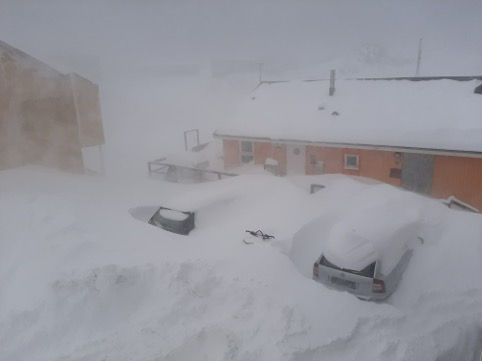
As snow materialises and moves, it also 3) takes up space – on top of houses, roads, mountains, covering dogs, cars and literally anything on which it lands. An example of this was shared by one of my human interlocutors (a woman who grew up in Nuuk and later moved to Ilulissat) as she told me of her childhood memories of being snowed in during the winter:
Our house was not very tall – and it often got completely buried in snow. Therefore, all outer doors had to close inward. Otherwise, you could not get out. So, if it had snowed a lot, we could hear the wind going *SHUU* – whirling around the snow outside and howling around us – and then, suddenly, everything became dead silent. Then, we knew that we were inside the snowdrift. Then, there was no sound. We could not hear anything. Then, when we got up in the morning, we would open the door – and then, we would just start shovelling snow inside. All the way at the top [of the door]. You always had a shovel standing in the entrance of the house – also using washing bowls and such – and then we made a little hole. All the way at the top edges. And then, the oldest child – or whichever child could use a shovel – was dressed up and then thrown out of that hole with a shovel. And then, the door was shut. And then, you began to shovel from outside, so that the others could get out.
As snow takes up space, it therefore also takes up space in a non-material sense – in human minds. As discussed by Law (2009) through material semiotics, there exists an ongoing interaction between discourse and materiality. However, the way we humans ascribe meaning to matter is dependent on the matter itself. In this sense, discourse is somehow limited, as one cannot build stories out of nothing.
But the relation between discourse and matter is somehow interconnected, as it is also possible to shape matter through meaning. As these non-material representations of snow exist in our minds, they are related to a material reality. This means that our concrete, physical interactions with matter such as snow create echoes in our minds, shaping our everyday thoughts.
This leads me to the next capacity of snow, which was pointed out to me by another of my human interlocutors who told me that: 4) ‘snow is essentially life’. This thought, in turn, brought me to the realisation that snow essentially is life because snow essentially is water. My interlocutor explained that – during the winter – snow provides cover for most of the flora in and around Ilulissat, thereby protecting them from the low temperatures. During the melting period in spring, as snow transforms into water, it is a source of life in a different sense. As the landscape wakes up after a long winter, melted water from snow functions as a drinking source for many human and nonhuman lifeforms, as well as a breeding ground for mosquitoes.
With this information, I invite you to pause for a moment to study the following photograph:
What does it bring to your mind? Which ideas and which sensations?
The last capacity of snow that I encountered is that 5) it can produce impressions, which can be picked up by human senses. Snow produces sound (it squeaks when someone walks on it, but it also muffles other sounds, which makes the landscape turn quiet); it creates a clear flavour as it interacts with taste buds on a human tongue; it cools down human skin through touch, and iit can feel soft, hard or slippery; it has a fresh smell; it can blind human eyes through interaction with sunlight, and it can colour entire landscapes white.
These sensory impressions of snow are particularly important to human life. Through eyesight, snow can aid as a way of orientation as it moulds itself through interaction with other actors and creates, for example, footprints. Snow therefore has a revealing ability. This can aid human hunters during winter, as they can locate the animals by following their footprints in the snow. Snow further aids visual orientation as it creates the tracks used by dog sledge mushers or snowmobile riders, who use eyesight to locate these tracks and thereby orient themselves in the landscape.
But snow also reflects light. The father of a friend from the Icefjord Centre emphasised this during an interview, as he told me that:
The snow means a lot to us, because it lights up – especially when you are out in nature. Then you can see everything around you. When we don’t have snow here, during the fall, then it’s very dark. Especially here where we are, in the northern part of the country, where we have winter darkness. The sun disappears here in Ilulissat on November 28th – and then, it reappears only on January 13th. So, we have darkness for 1.5 months. Therefore, the snow means a lot for the light. First of all, it has a psychological influence because the darkness gets a bit lighter when we have snow. That’s probably the most significant thing about snow for us. The dark period is not so dark when the snow has arrived.

Conclusion
If you are still listening to the soundscape, I invite you to press pause now.
Did you do it?
Listen to the silence – to the absence of sound – or perhaps to the sounds around you, if there are any. I invite you to close your eyes for a moment and listen.
What did you hear? What can these sounds (or the absence of sounds) teach you about the environment you are a part of, at this moment in time?
The relations between humans and snow in Ilulissat are, in a sense, paradoxical. On one hand, snow enables certain practices in everyday human life, such as dog sledge riding, tracking footprints, navigating in the dark, skiing or transporting one’s children around town on small sledges. But, on the other hand, snow renders human life rather impractical, as it takes up space and hinders movement. It often blocks doorways, covers cars and slows down walking – either because it demands more energy to walk through snow while one’s feet are constantly sinking, or because the compressed snow in the streets transforms into ice. Through snow’s relations to humans and nonhumans in Ilulissat, its inherent agency as vibrant matter is thus revealed.
Of course, the capacities of snow exist without any relation to humans. But, as I am myself a human, it was impossible for me to study snow through a completely nonhuman lens. While snow itself produces impressions, it is only possible to experience them as a human through human capacities. However, those impressions reveal inherent material capacities of snow, rather than solely interpretations of them.
The sensory and artistic methods I used during my research have therefore proven to be particularly important, as they have allowed me to deeply experience snow’s capacities. I was able not only to capture the vibrancy of snow through notes and human narratives, but further through sensory ethnography, photography and the recording of soundscapes. Through the process of research, these methods heightened my attention towards the sounds, smells, touch, flavours and visual aesthetics of snow in Ilulissat.
In this sense, artistic methods are especially important because they can act as a mediator between species. They can translate that which escapes human writing and they can bind multiple species through collaboration in the process of making art. Hopefully, they can contribute to deeper levels of understanding.
Thank you for reading, listening and viewing my work. It was a pleasure, dear reader.
Epilogue
One of these days, whenever you embark on your next walk, I invite you to bring a sound recording device along. Then, record the sounds you meet as you move through an outside space, listen to them, notice which sounds are louder than others, which sounds surprise you, whatever you can think of. Notice how these sounds influence your perception of a certain environment; notice how you move through space if you focus attentively on your physical sensations.
Artnographic statement
This essay is based on an ethnographic fieldwork in Ilulissat, Kalaallit Nunaat, carried out from early February to early May 2022. The fieldwork was part of my Master’s programme in Cultural Anthropology: Sustainable Citizenship at Utrecht University in the Netherlands.
During my time in Ilulissat, I was researching how human-snow relations partake in a larger assemblage that shapes the everyday practices and lifeworlds of local residents, inspired by Jane Bennett’s (2010) work on vibrant matter. In this essay, I have invited you to experience some of the things I found, as well as to think about ethnographic methods through a nonhuman, artistic lens.
Because I have a background in art and movement studies, I decided to make use of more-than-traditional ethnographic methods during my fieldwork in Ilulissat. I decided to draw on my experiences of studying humans and nonhumans with different tools, such as intuition, artful expression and the senses of the physical human body.
My background in art includes studies in drawing, painting, ceramics, printmaking and dance at two Danish folk schools over a period of twelve months in 2013, 2015 and 2016. In addition, I spent a year at Aarhus Art Academy in 2016–2017 where I studied drawing, sculpture, clay, colour theory, video making and art history. My background in movement studies includes a year of studies in psychomotor therapy at University College Copenhagen, 500 hours of vinyasa yoga teacher training and 200 hours of training in somatic approaches to yoga.
In the fall of 2021, as I prepared for my ethnographic fieldwork in Ilulissat, I quickly realised that artistic and sensory methods were crucial to my research on human-snow relations. I wanted to interview the human residents of Ilulissat, as well as partake in their everyday lives and activities as best as I could, but I also wanted to engage with the snow itself. It was important to me to explore how snow and I would influence each other, over time, through our own relation. I therefore decided to make use of the tools I knew from my previous studies. I knew that I would not be able to interview snow, in the same way that I interviewed humans, since snow did not speak any human languages. However, it did make sounds of its own – as well as other sensory impressions – that could be experienced by a human body and captured by human-made recording devices and turned into art.
What is art, then? I know from art history that this question is equivalent to asking a group of anthropologists to agree on a simple definition of culture. However, in my experience, art is simply an authentic, honest expression. It is something that can be made of anything, with any intention behind it. In the case of my fieldwork, the art I produced is made of sensory impressions, through a camera, a recording device and fieldnotes, in collaboration with snow, with the purpose of sharing my own sensory impressions and the ways in which I and other humans related to snow.
Before deciding on my artistic mediums, there was an important choice to be made: how could I transport sensory impressions over a great distance? I decided that I would not attempt to transport snow itself back to the Netherlands where I live. Even if I could have succeeded, snow behaves quite differently in an arctic climate than in a temperate one. That whole endeavour would have therefore defeated the purpose of allowing other humans to experience snow as it was in Ilulissat. This excluded touch, taste and smell (except for my own descriptions, transported through my fieldnotes). I therefore chose to explore how to transport the audio and visual sensory experiences with me. So, I decided to bring a sound recording device and a camera to Ilulissat.
The final soundscapes and photographs, which you have encountered here, expose snow in different forms, at different stages, in relation to different agents, shaped by changes in temperature, over time. They are sensitive pieces of art, made of feelings, intuitions and impulses at specific moments. They are subjective, as they are formed by my own beliefs, background, research questions and aesthetic sense. What they expose is that snow indeed has an agency of its own – and that it has relations to the humans and other species with whom it shares space.
A note on ethics
Prior to, during and after my fieldwork in Ilulissat, it has been crucial for me to critically reflect on my own positionality in relation to the people and the place I was allowed to visit. There is a colonial history between Kalaallit Nunaat and Denmark, whose long-term effects are terrible and still influence the lives of the Inuit to this day. Since I am of Danish nationality, it has been necessary for me not only to approach this fieldwork with extreme care, but also to question whether it should be carried out at all.
In preparation for my fieldwork, I therefore turned to an Inuk friend with whom I was able to discuss how to best approach it in an ethical manner. It is important to highlight that, if my friend had not given me permission to go, I would not have carried out this project. I am aware that my friend is an individual and that they do not represent all people of Kalaallit Nunaat. But I also know that they have a deep knowledge of our countries’ shared colonial history, as well as its current effects, so I chose to trust them on these matters.
Furthermore, I have been following the official guidelines of the Indigenous Circumpolar Counsel (ICC) (2) for ethical and equitable engagement with Indigenous Peoples. These guidelines include respecting and acting in accordance with Inuit values, respecting and avoiding misuse of Inuit knowledge, avoiding misconduct in Inuit communities, respecting Inuit methodologies for gathering information and validating knowledge, and always asking for informed consent.
Through several discussions with my friend, I realised that it deeply matters how we carry out ethnographic research and what we choose to study. The rights and safety of people are always more important than any research project, and it is important not to cause anyone harm or take space from someone else. It matters that we are kind to the people we meet, that we thoroughly research the places we visit before we go there, and it matters that we constantly are critical towards our own positionality and the actions we carry out – every single day.
For this particular research project, it felt valuable to carry it out as an ‘outsider’. Most people I met during my fieldwork did not understand why I wanted to study snow – ‘isn’t it just something we have?’ – or they were so used to dealing with snow on a daily basis that it was just another one of those boring, time consuming things that are part of everyday life. I, on the other hand, grew up without having to deal with heavy snowfall every winter. This resulted in me being the source of a great deal of laughter and pity as I tried to shovel snow for the first time. This happened before I arrived in Ilulissat, when I visited my friend in Nuuk, and we had to free their car from a heavy pile of snow in order to drive to the supermarket. In this sense, I had to learn a lot of things from scratch, and I often felt like a child – which I think makes the foundation for great anthropology.
-
Bennett, Jane. 2010. Vibrant Matter: A Political Ecology of Things. Durham, NC: Duke University Press.
-
Bourdieu, Pierre. 1977. Outline of a Theory of Practice (trans. Richard Nice). Cambridge: Cambridge University Press.
-
Braun, Bruce. 2008. ‘Environmental issues: Inventive life’. Progress in Human Geography 32 (5): 667–79.
-
Coole, Diana and Samantha Frost (eds). 2010. New Materialisms: Ontology, Agency, and Politics. Durham, NC: Duke University Press.
-
Deleuze, Gilles and Félix Guattari. 1987. A Thousand Plateaus: Capitalism and Schizophrenia (trans. Brian Massumi). Minneapolis: University of Minnesota Press.
-
Haraway, Donna. 1991. ‘A cyborg manifesto: Science, technology, and socialist-feminism in the late twentieth century’. In Simians, Cyborgs and Women: The Reinvention of Nature, pp.149–81. New York: Routledge.
-
Haraway, Donna. 2008. When Species Meet. Minneapolis: University of Minnesota Press.
-
Ilulissat Icefjord Centre. Homepage. 13 December 2023: https://isfjordscentret.gl/en/ilulissat-icefjord-centre/
-
Ingold, Tim. 2000. The Perception of the Environment: Essays on Livelihood, Dwelling and Skill. New York: Routledge.
-
Ingold, Tim and Jo Lee Vergunst. 2008. Ways of Walking: Ethnography and Practice on Foot. New York: Routledge.
-
Inuit Circumpolar Council. 2023. ‘Ethical and Equitable Engagement Synthesis Report: A collection of Inuit rules, guidelines, protocols, and values for the engagement of Inuit Communities and Indigenous Knowledge from Across Inuit Nunaat’. Synthesis Report. International.
-
Jackson, Michael. 1983. ‘Knowledge of the body’. Man, New Series 18 (2): 327–45. London: Royal Anthropological Institute of Great Britain and Ireland.
-
Law, John. 2009. ‘Actor Network Theory and material semiotics’. In Bryan S. Turner (ed.), The New Blackwell Companion to Social Theory. Oxford: Blackwell Publishing Ltd.
-
Pink, Sarah. 2015. Doing Sensory Ethnography. Second Edition. London, California, New Delhi, Singapore: SAGE Publications.
-
Sundberg, Juanita. 2011. ‘Diabolic caminos in the desert and cat fights on the Río: A posthumanist political ecology of boundary enforcement in the United States-Mexico borderland’. Annals of the Association of American Geographers 101 (2): 318–36.
-
